Swim Assessments

At Swim Lab, assessments are an important part of your child’s swimming journey. They help us track progress, celebrate milestones, and ensure that every swimmer builds a strong foundation before moving forward.

We’ve put together this FAQ to answer the most common questions parents have about assessments — from when they happen, to what happens if your child is absent, and how you can support their growth in the pool.

What is the purpose of the assessment?

Assessments help us understand each child’s swimming level, track progress, and ensure they are placed in the most suitable class. This ensures safety and maximises learning outcomes.

How is Swim Lab’s assessment different from other swim schools?

  • While each swim school has its own internal assessments, the overall goals are similar: water safety, confidence, and skill development.
  • At Swim Lab, we focus on building a strong foundation for every swimmer.
  • Children typically start with one stroke and progressively build skills step by step. By the end of the foundation stage, they will have achieved the basics of all four strokes: freestyle, breaststroke, backstroke, and butterfly.
  • Our assessments ensure that each child has properly mastered the fundamentals of each stroke before progressing to more advanced levels.
  • We follow a systematic and structured approach, ensuring consistent skill development, water confidence, and long-term progress.

Who will conduct the assessment?

All assessments are conducted by our Head Coach and/or certified Swim Lab coaches, who are trained to evaluate skills, technique, and water confidence.

When are assessments conducted?

  • Assessments are conducted periodically at each pool, on designated weeks.
  • Assessment weeks will be highlighted in the class schedule. Parents should take note and ensure their child attends on the scheduled assessment day. Attendance during assessment weeks is important for accurate evaluation and class placement.
  • Assessments take place during the child’s regular class — there is no change to the schedule of your swim lesson.

How often are assessments conducted?

Assessments are conducted once every term.

This allows children sufficient time to develop and consolidate their skills between assessments, ensuring that progress is meaningful and accurately reflected.

How long does an assessment take?

The assessment will take place during the duration of the whole lesson.

What will be assessed?

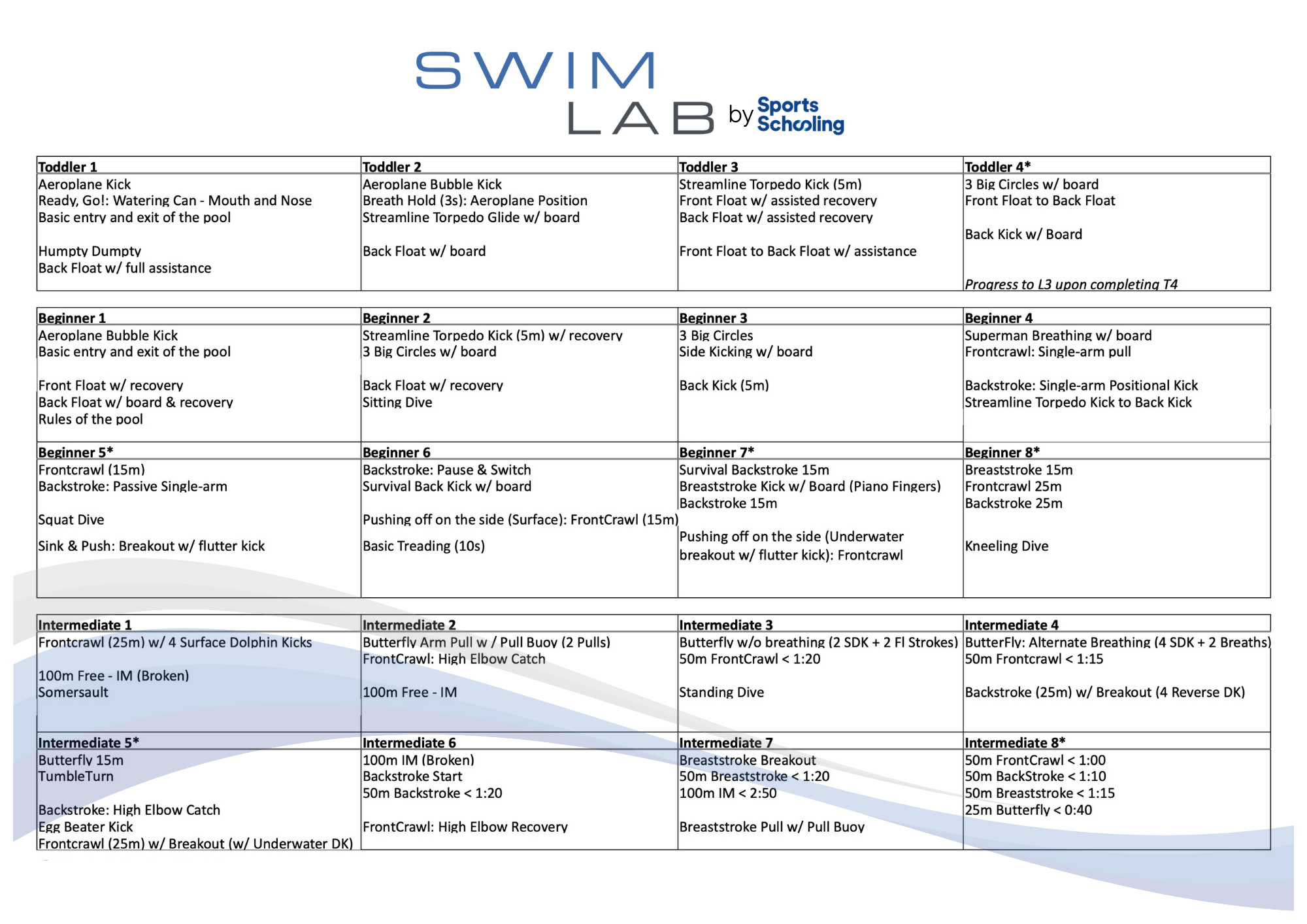
During assessments, swimmers will be evaluated on the specific skills required for their respective levels. Please refer to the block plan for each level for a clearer understanding.

Do I need to register separately for assessments?

No, assessments are part of the Learn-to-Swim programme. Our team will automatically schedule them based on your child’s class.

Will my child move up a level immediately?

Placement decisions are based on each child’s performance and progress over time. Some children may advance immediately if they demonstrate readiness, while others may need additional practice and skill development before moving up.

Progress updates and assessment results are shared with parents via the Sports Schooling app after each assessment. All placement decisions are at the coach’s discretion and are final; however, parents are welcome to consult the coach to learn how to best support their child’s improvement.

Every child develops at their own pace — consistent practice and encouragement are key to making progress.

Is there an extra fee for assessments?

No. Assessments are included as part of your child’s programme fees.

Can parents watch the assessment?

Yes, where pool safety and space allow, parents may observe from designated areas. Coaches will provide guidance and feedback after the assessment.

What if my child does not pass the assessment?

  • “Not passing” an assessment does not mean failure. It simply indicates that your child may need more practice to develop certain skills.
  • Coaches will provide guidance and recommendations to help your child progress. Placement decisions are always made with the child’s best interest in mind.

How long does it typically take for swimmers to move up to the next level?

  • The timeline for progression varies for each child, depending on their learning pace, confidence, and skill mastery.
  • Some swimmers may advance within a few terms, while others may take longer to consolidate skills. Every child takes a different amount of time to reach milestones.
  • Regular practice, attendance, and encouragement play a key role in helping your child progress.
  • Coaches will provide guidance and updates via the Sports Schooling app to help parents understand each child’s readiness for the next level.

What if my child is sick on assessment day?

  • If your child is unwell and cannot attend class during assessment week, a make-up assessment can be scheduled at a later date.
  • Please inform your instructor or Swim Lab Customer Service as soon as possible to arrange an alternative session.

What if my child's class is cancelled due to wet weather or other unforeseen circumstances?

  • If a class is cancelled, the assessment will be rescheduled to the next available class or assessment week.
  • Parents will be notified of the new date via email, WhatsApp, or the class communication channel.

Can one ever fully “master” a stroke?

  • Swimming is a skill that can always be refined. Even advanced swimmers continue to improve technique, efficiency, and speed over time.
  • At Swim Lab, our goal is for children to build a solid foundation and proper technique for each stroke.
  • “Mastery” is a continual process — the focus is on confidence, consistency, and correct form, which provides a strong base for lifelong swimming skills.

How can I encourage and support my child after each assessment?

  • Every assessment is an opportunity for your child to learn, build resilience, and track their progress, regardless of whether they move up a level.
  • Celebrate their effort and improvement, not just the results.
  • Discuss the feedback from the coach and identify specific skills to practice at home or during class.
  • Encourage consistent practice and a positive attitude — every child improves at their own pace.
  • Use the assessment results to set achievable goals and motivate your child for the next session.